
Published November 7, 2026 · Updated November 7, 2026 · Originally shared on LinkedIn
Before I change anything on an estate planning page, I read the search results for the query it should answer. The results show what kind of page Google currently favors, so the change starts from evidence instead of a keyword guess. This note walks through the five-step check, using a hypothetical example.
Key takeaways
- A keyword is a hypothesis; the search results are the evidence.
- Classify the dominant intent before you compare any page.
- Write the observation, the interpretation, and the recommendation separately.
- Some audits should end with “leave the page alone.”
- For estate planning, the task is page mapping: which search deserves which page.
What Does It Mean to Classify a Search Query?
Classifying a query means writing down what the searcher appears to want before deciding what a page should do. For an estate planning firm, that might be finding a nearby attorney, researching one service, learning the basics, or comparing options. The label is a working hypothesis that the search results then confirm or challenge.
| Query | What it appears to ask for | Page the searcher may expect |
|---|---|---|
| estate planning attorney near me | A nearby provider | A firm or profile page with location and a way to contact |
| what is estate planning | An explanation | An educational guide |
| revocable living trust attorney | A specific legal service | A dedicated service page |
| how much does a living trust cost | Research and comparison | An explanation of fees, factors, and a next step |
These are illustrations of intent signals, not rules. All four relate to estate planning, but they are not necessarily asking for the same thing.
Step 1: Read the Query Before the Website
Start with the exact words searched, without tidying them into a nicer keyword. Modifiers such as “near me,” “what is,” “cost,” or a named legal service change the likely purpose of the search. Reading those words first stops the website from shaping your view of what the searcher wanted.
“Near me” gives an initial local-intent signal. It suggests the searcher may want a nearby provider, not just an explanation of estate planning. But a phrase only gives me a hypothesis. The search results give me the evidence to test it.
Step 2: Read the Search Results, Not Just the Keyword List
Open the actual results for the query and note what is there. Record the types of pages, whether local results appear, whether dedicated service pages or guides repeat, and whether directories or profiles show up. These observations are evidence about the search environment, which a keyword list alone cannot provide.
- What types of pages are appearing?
- Are local results present?
- Are dedicated service pages appearing?
- Are informational guides common?
- Are directories or profile pages appearing?
- Are there other features around the query?
Suppose the results for a query repeatedly show pages about revocable living trusts, while the page being evaluated is a broad “Estate Planning” overview. That does not automatically make the broad page wrong. It does give me something to investigate: does the page match the type of result the search appears to favor?
A Real Observation: The Same Query From Two Locations
Real observation · November 7, 2026On November 7, 2026, I searched “estate planning attorney near me” in Google twice: once from my own location in Jashore, Bangladesh, and once with Google reporting North Carolina from the IP address. Each returned a different mix of results, which shows how much “near me” depends on location.
| Search location | Observation | Interpretation | Recommendation |
|---|---|---|---|
| Jashore, Bangladesh | An AI Overview and a knowledge panel listed law chambers in Jashore. Below them, the organic results included national pages such as Fidelity, Yelp, ACTEC, FindLaw, and USA.gov, plus one sponsored result. | “Near me” depended on where I searched, so the same query can show a different mix of results in another market. | Read the results from the market the firm serves before classifying intent. |
| North Carolina (from the IP address) | A business panel and a map-based local pack of three estate planning firms appeared first, followed by a People also ask box. The organic results mixed a directory, an ACTEC guide, and law firm pages, some for firms in other states. | With a U.S. location, the same query returned a provider-discovery layout: local businesses first, then guides and firm pages. | For a firm in this market, check its Business Profile and service pages against this layout, not only its website. |
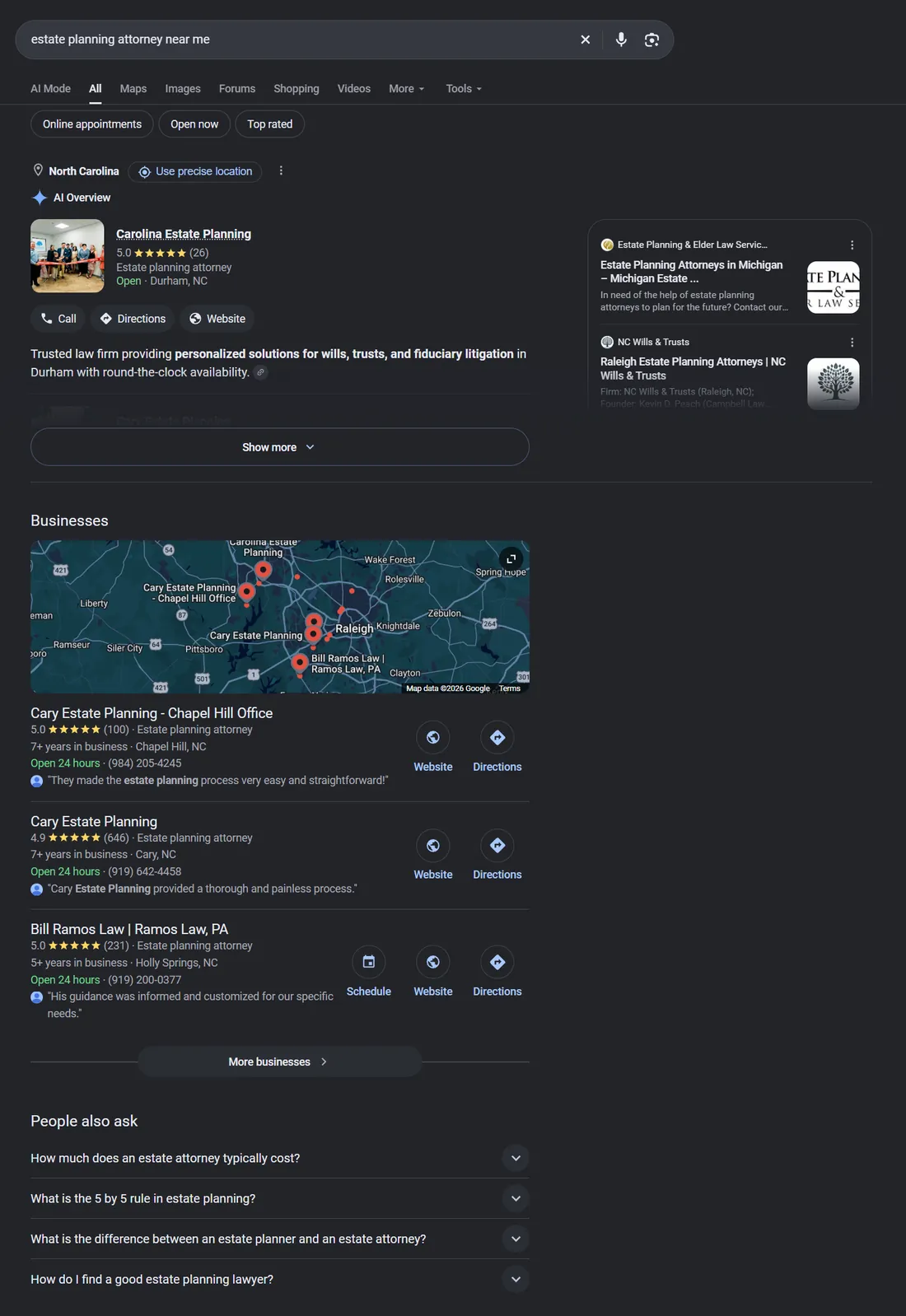
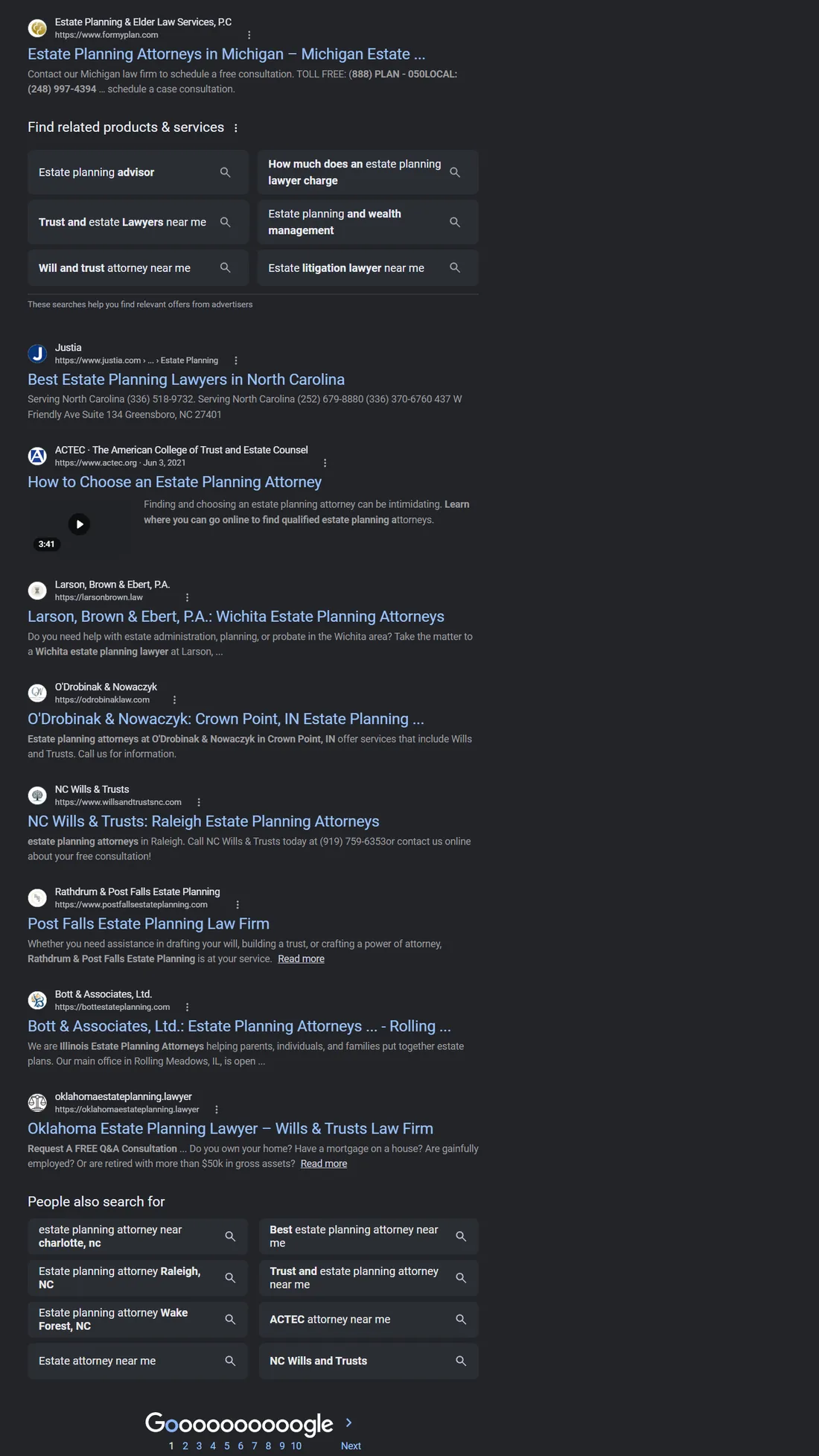
Results also vary by device and signed-in state, so treat this as a dated example of the method, not a ranking study.
Step 3: Classify the Dominant Intent
Give the query a working label, not because intent always fits one box, but because a label makes the audit structured. A simple set is local provider discovery, service-specific, informational, research or comparison, and transactional. The useful part is what the label helps you decide next.
For “estate planning attorney near me,” I would start with local provider discovery. That tells me what to examine next: whether the firm’s profile, location information, and service pages make sense for someone choosing a provider. Real searches can mix intents, so I look for the dominant need and keep the secondary ones in mind.
Step 4: Compare Your Page With What the Results Show
Now open the website and compare the page with the search environment you just observed. Ask whether it answers the visitor’s need, whether its page type matches, whether its scope is clear, and whether you would click it as a searcher. This comparison finds problems a standard checklist often misses.
Does this page answer the right need?
A visitor from a provider-oriented search needs to understand who the firm is, what it offers, where it operates, and how to take the next step.
Is the page type appropriate?
If the results repeatedly show specific service pages, a general homepage or broad article deserves closer scrutiny.
Is the scope of the page clear?
A page that tries to target wills, trusts, probate, Medicaid planning, and every other estate topic at once can blur its own intent.
Would it make sense as a result?
If I were the searcher, would this be the page I expected to click? That question often exposes what a checklist misses.
Step 5: Separate Evidence From Assumptions
Write down what you observed separately from what you think it means. An observation is a fact you can point to, such as several top results being dedicated service pages. An interpretation is your reading of it, and a recommendation is the action the evidence justifies. Keeping them apart makes advice easier to check.
Hypothetical example| Observation | Interpretation | Recommendation |
|---|---|---|
| Several top results are dedicated service pages | The query may have strong service intent | Investigate whether the firm’s page is too broad or a dedicated page would match better |
That sequence is stronger than jumping from “a competitor has a service page” to “create a service page.” The first is evidence. The second is an action, and there is reasoning in between.
Decide What Not to Change
A good audit does not need a long list of edits. Sometimes the page type already matches the results, the intent is already covered, or the real problem sits somewhere else. I prefer an audit that produces a few defensible recommendations over one that rewards the number of changes.
Do not edit just because you found something that could be edited. Edit when the evidence gives you a reason.
A 60-Second First Pass
For a first-pass review, the process reduces to five questions: what was searched, what the query appears to want, what the results show, whether the current page fits, and what the evidence justifies. The answers move in one line from the query to a next action, which is optimizing, restructuring, creating, consolidating, or leaving the page alone.
- What was searched? Write down the actual query, not a cleaned-up version.
- What does it appear to want? Classify the dominant intent.
- What is Google showing? Look at page types, local results, recurring themes, and features.
- Does the current page fit? Compare it with the searcher’s likely expectation.
- What does the evidence justify? Only now decide whether to change the page.
A Hypothetical Example: One Broad Estate Planning Page
Hypothetical example — not a real clientImagine a firm has one page called Estate Planning and wants it to rank for “revocable living trust attorney.” The page mentions trusts briefly but mostly discusses estate planning in general. Before rewriting anything, I would read the results for that exact query and see whether dedicated trust pages repeat there.
If they do, I would investigate four questions: Is the searcher expecting a dedicated service page? Does the current page give enough depth on this service? Would expanding it make sense? Or would a separate page create a clearer match?
Notice what I have not done yet. I have not added the phrase thirty times. The first decision is page-to-intent alignment, and optimization comes after it.
What I Record During the Audit
A simple worksheet keeps every recommendation tied to something observed. For each query, I record the exact phrase, the dominant intent, the page types that repeat, whether local results appear, recurring topics, the page being evaluated, how well it fits, the evidence, and the recommendation the evidence supports.
| Audit field | What I record |
|---|---|
| Query | The exact search phrase |
| Dominant intent | Local, service, informational, or other |
| Result page types | Which formats repeatedly appear |
| Local presence | Whether local results are visible |
| Recurring themes | Topics and questions that repeat |
| Current page | The URL being evaluated |
| Page-to-intent fit | Strong, partial, or weak |
| Evidence | What I actually observed |
| Recommendation | The next action that evidence supports |
The value is not the spreadsheet. It is the discipline of forcing each recommendation to connect back to an observation.
Common Mistakes I Try to Avoid
Four habits cause most unnecessary edits: starting with keyword volume, copying the top-ranking competitor, treating every query as purely informational or purely transactional, and editing before diagnosing. Each one skips the step where evidence connects a search to a page, so the change is made without a reason.
Starting with keyword volume
Volume can help prioritize, but it does not tell me what the page should be.
Copying the highest-ranking competitor
A competitor’s page is evidence about the results. It is not an instruction to reproduce it.
Treating every query as one kind of intent
A person searching for an attorney may still research pricing, services, credentials, or process first.
Editing before diagnosing
A checklist can produce dozens of possible changes. A good audit asks which ones are justified.
Why This Matters for Estate Planning Firms
Estate planning firms often have several commercially important services, and each can attract different searches. That makes the work as much a page-mapping problem as a keyword problem. The useful question is which search deserves which page, and what evidence supports that decision, rather than which keywords the firm should target.
A single firm might work across:
- Wills
- Trusts
- Probate
- Medicaid planning
- Asset protection
- Elder law
- General estate planning
For background on how searches connect to consultations, read How Local SEO Works for Estate Planning Firms, or see how findings are written in the audit examples.
Questions About Reading Search Results
These answers cover common questions about search intent and reading the results before an edit. Each one gives the short answer first, then the limit: search results change, vary by location, and show what Google presents today, so they inform a decision without proving what will happen after a change.
What is search intent in SEO?
Search intent is the underlying purpose or need behind a search. In an audit, it helps decide what type of result and page would best satisfy the searcher.
Why read the search results before optimizing a page?
The results show what Google currently presents for the query, including result types, local results, recurring topics, and other features. That evidence helps you judge whether the page you are optimizing matches the query.
Is “near me” always local intent?
“Near me” is a strong local modifier and commonly signals a search for nearby businesses. I would still inspect the actual results instead of relying on the phrase alone.
What should I check first in the results?
Start with the result types and page types. Then look at local-result presence, recurring topics, questions, and other prominent features, so you understand the search environment before deciding what to change.
Should every SEO audit lead to page changes?
No. An audit should produce recommendations supported by evidence. Sometimes the right outcome is to improve a page, restructure content, create a more specific page, or leave the current page unchanged.
How do I classify a search query?
Identify its dominant purpose, such as local provider discovery, a specific service, information, or comparison. Then use the results to test whether that first classification holds.
Does intent matter more than keyword volume?
They answer different questions. Volume helps prioritize opportunities, while intent shows whether an opportunity fits the page and the searcher’s need. For page-level decisions I would not use volume alone.
Can one keyword have more than one intent?
Yes. A query can have mixed intent. The practical goal is to identify the dominant intent in the results and keep the secondary needs in mind.
Bottom Line
For one estate planning query, the check can be as simple as reading the query, reading the results, classifying the intent, comparing the page, and then deciding. That order makes a recommendation easier to explain, easier to document, and easier to challenge if the evidence changes. My focus is defensible recommendations, not more tactics.
Want This Check Run on Your Firm’s Page?
Start with a free one-page review of your public Google Business Profile, delivered by email. No account access is needed, and you can decide afterward whether to discuss separate paid work.
Request a Free ReviewEditorial note: This article shares a working method and general information about website practices. It is not legal advice, and it does not promise rankings or inquiries. Examples marked hypothetical are illustrations, not real client results.
Keep reading
- Google Business Profile Checklist for Estate Planning Firms
- Eight Website Issues a Law-Firm Audit Found
- Local SEO Audit for Estate Planning Law Firms
About the author
Sohanur Rahman · Local SEO specialist · Jashore, Bangladesh
My hands-on work includes law firm website SEO and Local SEO support, with examples attributed to their original practice areas and industries. I work remotely and I do not claim a U.S. office or team.